Industrial History Online
Haverhill Rope, Twine & Sack Co
Key Words :- ropewalk
Address :- Old Rope Walk, Haverhill, Suffolk
Grid Ref :- TL 661 452
Co-ordinates :- Lat 52.080241 , Long 0.422527
Local Authority :- West Suffolk Council
Pre 1974 County :- Suffolk
Site Status :- Site demolished or no longer extant
Description and History of Site:-
Works: Camps Road
Office: 35 Queen Street
The site was immediately north (downhill) of the waterworks in Camps Road and the site has been redeveloped for housing, known as 'Old Rope Walk'.
It was a sizable site and ran up to what is now York Road on the Clements Estate.
The rope walk was 120 yards long thus enabling 100 yard ropes to be produced and was made from WW1 army billet huts joined end to end. The company dates from around 1880.
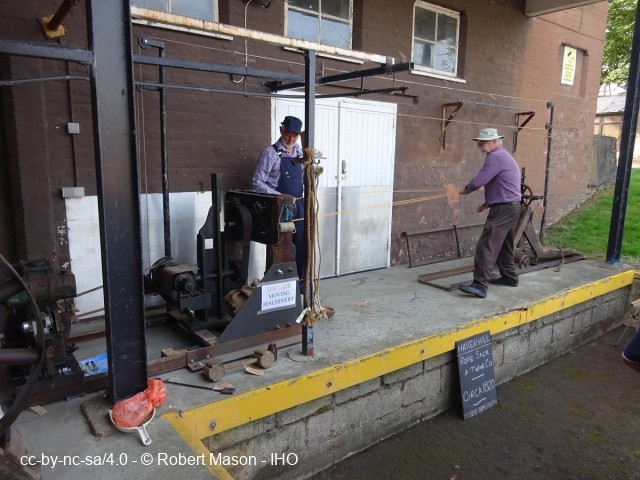
There were two rope twisting machines constructed into the timberwork of the buildings and they were driven via overhead countershafting from steam then oil engines situated outside.
They moved from that site in 1978 to new premises in Homefield Road. They were only there for a couple of years before closing for good.
A machine (known as a twister) has been restored (rebuilt with a Lister D engine and some grass rails) and makes appearances at heritage events in East Anglia. The second machine is set up but not working at the Museum of East Anglian Life (The Museum of Food) in Stowmarket.
A SUFFOLK ROPE-WALK
by E. J. Yaxley
In a few East Anglian towns, 'Rope Walk' is merely the local place name of a road or street, thus named for its former connections with a once flourishing rural industry.
The West Suffolk market town of Haverhill, however, can boast a more substantial reminder of an almost vanished handicraft. A rope-walk, reputedly the only one in East Anglia and the property of the Haverhill Rope Company (est. 1880, present director Mr. T. Farr), still exists and, although rope-making is almost fully automated nowadays, the means are still available at Haverhill for making a rope by the old method.
The 'walk' is, quite simply, a 300 foot long hut beneath whose roof the old rope-makers would walk - or rather shuffle - backwards as their 'yarns', 'strands' or 'cords' lengthened, depending on whatever stage of manufacture a rope had reached.
Formerly the making of a rope was the work of a team, a man 'walking' and a boy turning by hand a cumbrous wooden spinning wheel, the lad's first and - one can imagine - most laborious job on entering the trade.
Raw jute, imported from the Ganges valley, was teased or 'heckled' on a block of steel spikes, leaving behind a fibrous wad of 'tow'. (The word 'heckle' - to tease or taunt - may well have had its origin in rope-making.) This wad was the rope-makers 'strick' which he secured to his front at the waist-line. Then a few fibres were drawn out and attached to small spinning reels on a board above the wooden wheel.
Now the lad would spin the big wheel by means of a cranked handle at its hub and the wheel in turn would drive the reels as the man began his slow backward shuffle along the walk, pulling out fibres from his 'strick' as he went. Often the full 300 feet of the walk would be used, the lengthening rope laid across wooden supports swung out from the walls.
These wheels, one of which is still in working order at the Haverhill works, were last used by the man and boy teams in 1920. Then, as in other industries, machines replaced men and quite literally reversed the process of manufacture. Where before the man moved backward along the 'walk' as his rope was built up, now a 'back-cart', keeping the rope in tension, is pulled up the walk on wooden runners towards a twisting machine - the yarn shortening as it is twisted into a strand.
Finished ropes were sometimes given a final polish to lay flat any protruding fibres or flecks of jute bark known as 'chive'. A mixture of flour and water was rubbed on the hands and the rope-maker, grasping the laid-out rope, moved sideways down the walk running his hands to the rope's end. This mixture was found most palatable by some of the employees and much of it was secretly taken for home cooking. Unfortunately, the governor, to prevent further misappropriation, rendered it less palatable by adding an ingredient of his own.
Eventually, man ever seeking an easier method, a way was found to 'mechanise' the polishing. A twist of rope or 'bass' was held around the rope and attached by a lead to a donkey. Man supplied the pressure and donkey performed the polishing, travelling up and down the walk.
The existing walk is a comparatively modern affair but its forerunner, which stood on the same site, was merely a windowless wooden shack - air and light being admitted by raising one side section. During bad weather the rope-maker needed to be a hardy type.
The rope-works grew up in this corner of West Suffolk in 1880 to meet a variety of demands from an agricultural community. Such everyday things as ropes, halters and reins were in great demand for general farm use. Even now, with the tractor all but completely replacing the horse on the land, plough cords are occasionally required for turning a plough-horse at the end of a furrow.
The rein and halter still find customers today in the world of race-horses, along with feeding nets. Anything from a hawser of several tons breaking strain to a clothes line could be made at the Haverhill rope-walk, although the type of product has remained much the same for years, with a slight change during two world wars. Then came orders for rope handles needed for ammunition boxes and netting for camouflage.
Among the rope-making fraternity there is known an expression of macabre origin - 'to be killed by a Bridport Dagger'. As the name suggests, the object was of West Country manufacture and doubtless kept rope-makers busy for many years until capital punishment was abolished. For the 'daggers' were hangman's ropes.
Another saying in the trade, thought to be the motto of the rope-makers guild is 'may hemp bind those that humour won't'. A reminder of the firm commitments and possibly harsh terms of contract laid upon the shoulders of young apprentices long ago; and of the loyalty expected from a craftsman.
Situated on the town's extreme western edge, almost overwhelmed by the G.L.C. 'overspill' houses, the rope works thrives. Away from the unit factories and neon lights of the modern industrial estate, the basic principles are still applied in rope manufacture. Its comparatively peaceful location is appropriate to the traditions of a country craft.
Old office is now a dental practice.
Further Reading and References:-
https://www.youtube.com/watch?v=cMIf14X2UzQ
Yaxley, E J. 'A Suffolk Rope-Walk'. essay, 1967
Help us improve this entry
Grid Ref :- TL 661 452
Co-ordinates :- Lat 52.080241 , Long 0.422527
Local Authority :- West Suffolk Council
Pre 1974 County :- Suffolk
Site Status :- Site demolished or no longer extant
Works: Camps Road
Office: 35 Queen Street
The site was immediately north (downhill) of the waterworks in Camps Road and the site has been redeveloped for housing, known as 'Old Rope Walk'.
It was a sizable site and ran up to what is now York Road on the Clements Estate.
The rope walk was 120 yards long thus enabling 100 yard ropes to be produced and was made from WW1 army billet huts joined end to end. The company dates from around 1880.
There were two rope twisting machines constructed into the timberwork of the buildings and they were driven via overhead countershafting from steam then oil engines situated outside.
They moved from that site in 1978 to new premises in Homefield Road. They were only there for a couple of years before closing for good.
A machine (known as a twister) has been restored (rebuilt with a Lister D engine and some grass rails) and makes appearances at heritage events in East Anglia. The second machine is set up but not working at the Museum of East Anglian Life (The Museum of Food) in Stowmarket.
A SUFFOLK ROPE-WALK
by E. J. Yaxley
In a few East Anglian towns, 'Rope Walk' is merely the local place name of a road or street, thus named for its former connections with a once flourishing rural industry.
The West Suffolk market town of Haverhill, however, can boast a more substantial reminder of an almost vanished handicraft. A rope-walk, reputedly the only one in East Anglia and the property of the Haverhill Rope Company (est. 1880, present director Mr. T. Farr), still exists and, although rope-making is almost fully automated nowadays, the means are still available at Haverhill for making a rope by the old method.
The 'walk' is, quite simply, a 300 foot long hut beneath whose roof the old rope-makers would walk - or rather shuffle - backwards as their 'yarns', 'strands' or 'cords' lengthened, depending on whatever stage of manufacture a rope had reached.
Formerly the making of a rope was the work of a team, a man 'walking' and a boy turning by hand a cumbrous wooden spinning wheel, the lad's first and - one can imagine - most laborious job on entering the trade.
Raw jute, imported from the Ganges valley, was teased or 'heckled' on a block of steel spikes, leaving behind a fibrous wad of 'tow'. (The word 'heckle' - to tease or taunt - may well have had its origin in rope-making.) This wad was the rope-makers 'strick' which he secured to his front at the waist-line. Then a few fibres were drawn out and attached to small spinning reels on a board above the wooden wheel.
Now the lad would spin the big wheel by means of a cranked handle at its hub and the wheel in turn would drive the reels as the man began his slow backward shuffle along the walk, pulling out fibres from his 'strick' as he went. Often the full 300 feet of the walk would be used, the lengthening rope laid across wooden supports swung out from the walls.
These wheels, one of which is still in working order at the Haverhill works, were last used by the man and boy teams in 1920. Then, as in other industries, machines replaced men and quite literally reversed the process of manufacture. Where before the man moved backward along the 'walk' as his rope was built up, now a 'back-cart', keeping the rope in tension, is pulled up the walk on wooden runners towards a twisting machine - the yarn shortening as it is twisted into a strand.
Finished ropes were sometimes given a final polish to lay flat any protruding fibres or flecks of jute bark known as 'chive'. A mixture of flour and water was rubbed on the hands and the rope-maker, grasping the laid-out rope, moved sideways down the walk running his hands to the rope's end. This mixture was found most palatable by some of the employees and much of it was secretly taken for home cooking. Unfortunately, the governor, to prevent further misappropriation, rendered it less palatable by adding an ingredient of his own.
Eventually, man ever seeking an easier method, a way was found to 'mechanise' the polishing. A twist of rope or 'bass' was held around the rope and attached by a lead to a donkey. Man supplied the pressure and donkey performed the polishing, travelling up and down the walk.
The existing walk is a comparatively modern affair but its forerunner, which stood on the same site, was merely a windowless wooden shack - air and light being admitted by raising one side section. During bad weather the rope-maker needed to be a hardy type.
The rope-works grew up in this corner of West Suffolk in 1880 to meet a variety of demands from an agricultural community. Such everyday things as ropes, halters and reins were in great demand for general farm use. Even now, with the tractor all but completely replacing the horse on the land, plough cords are occasionally required for turning a plough-horse at the end of a furrow.
The rein and halter still find customers today in the world of race-horses, along with feeding nets. Anything from a hawser of several tons breaking strain to a clothes line could be made at the Haverhill rope-walk, although the type of product has remained much the same for years, with a slight change during two world wars. Then came orders for rope handles needed for ammunition boxes and netting for camouflage.
Among the rope-making fraternity there is known an expression of macabre origin - 'to be killed by a Bridport Dagger'. As the name suggests, the object was of West Country manufacture and doubtless kept rope-makers busy for many years until capital punishment was abolished. For the 'daggers' were hangman's ropes.
Another saying in the trade, thought to be the motto of the rope-makers guild is 'may hemp bind those that humour won't'. A reminder of the firm commitments and possibly harsh terms of contract laid upon the shoulders of young apprentices long ago; and of the loyalty expected from a craftsman.
Situated on the town's extreme western edge, almost overwhelmed by the G.L.C. 'overspill' houses, the rope works thrives. Away from the unit factories and neon lights of the modern industrial estate, the basic principles are still applied in rope manufacture. Its comparatively peaceful location is appropriate to the traditions of a country craft.
Old office is now a dental practice.
https://www.youtube.com/watch?v=cMIf14X2UzQ
Yaxley, E J. 'A Suffolk Rope-Walk'. essay, 1967
The compilers welcome corrections or additional information on all sites.
Any information provided will be verified before appearing on the web site.
Email comments
Contributor :- Suffolk IA - 23 August 2023
Copyright :- cc-by-nc-sa 4.0 © Suffolk IA
Copyright :- cc-by-nc-sa 4.0 © Suffolk IA