Industrial History Online
Former wheelworks
Key Words :- workshop
Address :- 60 Farringdon Road, Clerkenwell, London, Greater London, EC1R 3GA
Grid Ref :- TQ 31330 82221
Co-ordinates :- Lat 51.523643 , Long -0.108375
Local Authority :- Islington London Borough Council
Pre 1974 County :- Middlesex
Site Status :- Site extant - No Protection
Description and History of Site:-
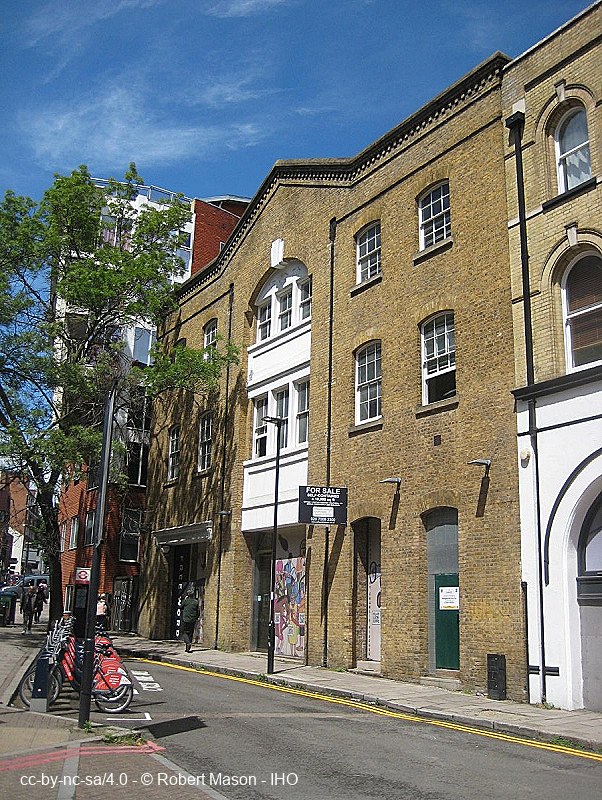
The rather handsome yellow-brick property known as 60 Farringdon Road in Clerkenwell was recently advertised as to let, described as a 'converted Victorian warehouse originally constructed in 1875'. The date was correct — but then it does appear on the front gable. The rest was wrong. 60 Farringdon Road never was a warehouse; rather it is, at least externally, a rare survival — a purpose-built wheelworks. It is a building type which has almost totally disappeared from London, and indeed elsewhere. But when road transport by definition involved wheels and horses, it was a crucial part of the system which kept the city and its economy moving.
It was not a small sector. London had over 330 wheelwright businesses in 1871, 320 in 1891 (and even 160 in 1921), with over 20 firms in Clerkenwell. Wheelwrights not only made and maintained wheels; they made vehicles too, carts and wagons, many of them of specialist types. Coachbuilders and makers, mainly producing carriages of many types but some in commercial vehicle production too, numbered well over 200 in the later decades of the Victorian period. Numbers employed were substantial; at the peak there were well over 10,000 workers in the wheelwright and carriage-making sectors in London, and that figure does not include ancillary trades such as blacksmithing, harness making and painting. Over time, with the introduction of motor vehicles, the sectors inevitably declined — though perhaps not as fast as is often assumed — and many businesses, including 60 Farringdon Road, shifted into motor vehicle building and repair.
The works were commissioned by Thomas Charles Robson, one of a large multi-generational family of, mainly, wheelwrights. His business, employing around 40 men — so a large one by contemporary standards — had been based in Laystall Street and in Liquorpond Street, now Clerkenwell Road, but was forced to move when the Metropolitan Railway was built. Like most wheelwrights Robson built entire vans and carts as well as their wheels — hence the two large vehicle entries onto the street. The new shop had the most up-to-date kit for its day: four forges, iron binding machines, drilling machines, a furnace for making iron tyres, a sinking platform for shrinking the red-hot tyres onto wooden wheels and numerous cranes. All of this was hand-worked (Robson failed to get the premises classed as a 'manufactory', and hence liable for lower rates, as there was no steam working). As motor vehicles ousted — over a long period — the market for horse-drawn vehicles, the Robsons turned to building bespoke bodies for motor vans instead. The business survived until 1969, when much of the original kit was still in place. It disappeared as the building was re-used as a film and recording studio and then as The Guardian's archives centre. From 2009 it housed numerous organisations concerned with literature and preventing censorship, but sadly the charity running the centre gave up during the pandemic. So it awaits yet another new purpose.
Valerie Bayliss, GLIAS Newsletter October 2022
Further Reading and References:-
http://www.glias.org.uk/news/322news.html#I
Help us improve this entry
Grid Ref :- TQ 31330 82221
Co-ordinates :- Lat 51.523643 , Long -0.108375
Local Authority :- Islington London Borough Council
Pre 1974 County :- Middlesex
Site Status :- Site extant - No Protection
The rather handsome yellow-brick property known as 60 Farringdon Road in Clerkenwell was recently advertised as to let, described as a 'converted Victorian warehouse originally constructed in 1875'. The date was correct — but then it does appear on the front gable. The rest was wrong. 60 Farringdon Road never was a warehouse; rather it is, at least externally, a rare survival — a purpose-built wheelworks. It is a building type which has almost totally disappeared from London, and indeed elsewhere. But when road transport by definition involved wheels and horses, it was a crucial part of the system which kept the city and its economy moving.
It was not a small sector. London had over 330 wheelwright businesses in 1871, 320 in 1891 (and even 160 in 1921), with over 20 firms in Clerkenwell. Wheelwrights not only made and maintained wheels; they made vehicles too, carts and wagons, many of them of specialist types. Coachbuilders and makers, mainly producing carriages of many types but some in commercial vehicle production too, numbered well over 200 in the later decades of the Victorian period. Numbers employed were substantial; at the peak there were well over 10,000 workers in the wheelwright and carriage-making sectors in London, and that figure does not include ancillary trades such as blacksmithing, harness making and painting. Over time, with the introduction of motor vehicles, the sectors inevitably declined — though perhaps not as fast as is often assumed — and many businesses, including 60 Farringdon Road, shifted into motor vehicle building and repair.
The works were commissioned by Thomas Charles Robson, one of a large multi-generational family of, mainly, wheelwrights. His business, employing around 40 men — so a large one by contemporary standards — had been based in Laystall Street and in Liquorpond Street, now Clerkenwell Road, but was forced to move when the Metropolitan Railway was built. Like most wheelwrights Robson built entire vans and carts as well as their wheels — hence the two large vehicle entries onto the street. The new shop had the most up-to-date kit for its day: four forges, iron binding machines, drilling machines, a furnace for making iron tyres, a sinking platform for shrinking the red-hot tyres onto wooden wheels and numerous cranes. All of this was hand-worked (Robson failed to get the premises classed as a 'manufactory', and hence liable for lower rates, as there was no steam working). As motor vehicles ousted — over a long period — the market for horse-drawn vehicles, the Robsons turned to building bespoke bodies for motor vans instead. The business survived until 1969, when much of the original kit was still in place. It disappeared as the building was re-used as a film and recording studio and then as The Guardian's archives centre. From 2009 it housed numerous organisations concerned with literature and preventing censorship, but sadly the charity running the centre gave up during the pandemic. So it awaits yet another new purpose.
Valerie Bayliss, GLIAS Newsletter October 2022
http://www.glias.org.uk/news/322news.html#I
The compilers welcome corrections or additional information on all sites.
Any information provided will be verified before appearing on the web site.
Email comments
Contributor :- GLIAS Database - 7 October 2022
Copyright :- cc-by-nc-sa 4.0 © GLIAS Database
Copyright :- cc-by-nc-sa 4.0 © GLIAS Database