Industrial History Online
Windmill Bridge No. 205 (Three Bridges)
Key Words :- canal aqueduct railway bridge
Viewing the Site :- From road on top bridge or from canal towpath under road and above the railway.
Address :- Windmill Lane, London, Greater London
Grid Ref :- TQ 1424 7965
Co-ordinates :- Lat 51.504247 , Long -0.355429
Local Authority :- Ealing London Borough Council
Pre 1974 County :- Middlesex
Site Status :- Scheduled Ancient Monument SAM
Historic England List No :- 1002020,
Site Condition :- Operational site, in use for original purpose
Site Dates :- 1859 -
Description and History of Site:-
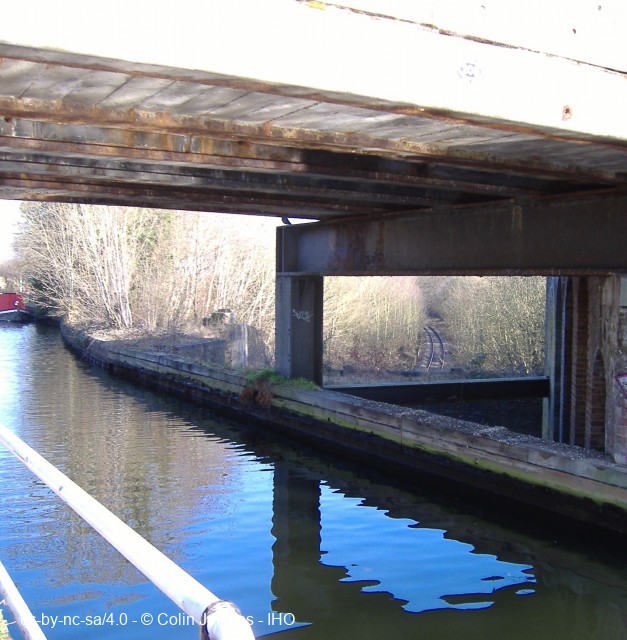
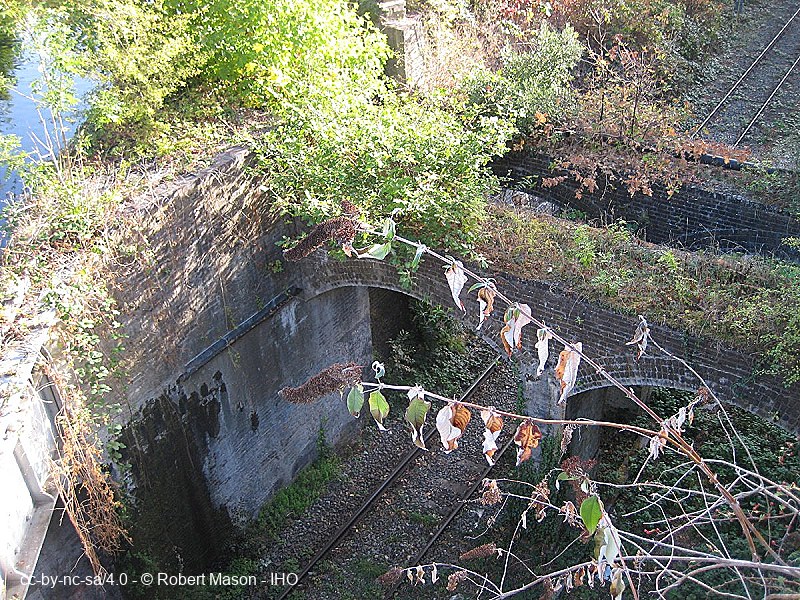
Better known as Three Bridges. Surviving three-level intersection, canal under road with rail beneath.
Cast-iron aqueduct structure built 1859 by GWR over their single track branch to Brentford Docks.
Cast-iron road bridge by 'MATTw T SHAW, 64 CANNON STREET CITY'.
Information panel:
Since the 1750s there has been intense competition between the great transport rivals to carry freight by canal, railway or road. Windmill Bridge is an unusual intersection of all three transport systems.
Long after the canal was built the Great Western and Brentford Railway proposed a line connecting Brentford Dock with the main line at Southall. The route of the railway avoided violating Osterley Park. The railway company commissioned its foremost engineer, Isambard Kingdom Brunel, to design the intersection of the road, canal and rail routes. The resulting structure includes a cast-iron trough or aqueduct carrying the Grand Union Canal over the railway, above which is a cast-iron bridge carrying the public road Windmill Lane over the canal. Windmill Bridge, as it is formally known, was Brunel's last major undertaking and was completed in 1859, the year of his death.
Canals were built to solve the problem of transporting goods on poor roads. When the railways were built they cut journey times further and made canals redundant. Today you can hear the M4 motorway where it crosses the canal below Hanwell Locks - road transport is popular once again.
1750s Packhorses
Laboriously slow and prohibitively expensive, a packhorse was the most frequently used method of carrying coal overland in the 1750s. Journeys above 15 miles were rare.
1810 A steady flow
Canal transport was more reliable, cheaper and faster than using packhorses. In 1810 a canal journey from Birmingham to London might take five to six days.
1830s Speed and power
Railway Mania gripped the nation during the 1830s-40s and by 1850 Britain's cities were connected by a rail network. Journeys that took days by canal could be completed in hours by the new railways.
1900s Delivery by diesel
In the early 20th century, petrol-engined and diesel-engined lorries began to change the face of bulk transport again.
Further Reading and References:-
Ashdown, John; Bussell, Michael; Carter, Paul. 'A Survey of Industrial Monuments of Greater London'. Thames Basin Archaeological Observers' Group, 1969
Falconer, Keith. 'Guide to England's Industrial Heritage'. Batsford, 1980
Wilson, Aubrey. 'London's Industrial Heritage'. David & Charles, 1967
Smith, Denis. 'Civil Engineering Heritage - London and the Thames Valley'. Institution of Civil Engineers, 2001
Perrett, David. 'London's Industrial Archaeology No 5', p35-38
http://www.glias.org.uk/journals/5-d.pdf
Help us improve this entry
Grid Ref :- TQ 1424 7965
Co-ordinates :- Lat 51.504247 , Long -0.355429
Local Authority :- Ealing London Borough Council
Pre 1974 County :- Middlesex
Site Status :- Scheduled Ancient Monument SAM
Historic England List No :- 1002020,
Site Condition :- Operational site, in use for original purpose
Site Dates :- 1859 -
Better known as Three Bridges. Surviving three-level intersection, canal under road with rail beneath.
Cast-iron aqueduct structure built 1859 by GWR over their single track branch to Brentford Docks.
Cast-iron road bridge by 'MATTw T SHAW, 64 CANNON STREET CITY'.
Information panel:
Since the 1750s there has been intense competition between the great transport rivals to carry freight by canal, railway or road. Windmill Bridge is an unusual intersection of all three transport systems.
Long after the canal was built the Great Western and Brentford Railway proposed a line connecting Brentford Dock with the main line at Southall. The route of the railway avoided violating Osterley Park. The railway company commissioned its foremost engineer, Isambard Kingdom Brunel, to design the intersection of the road, canal and rail routes. The resulting structure includes a cast-iron trough or aqueduct carrying the Grand Union Canal over the railway, above which is a cast-iron bridge carrying the public road Windmill Lane over the canal. Windmill Bridge, as it is formally known, was Brunel's last major undertaking and was completed in 1859, the year of his death.
Canals were built to solve the problem of transporting goods on poor roads. When the railways were built they cut journey times further and made canals redundant. Today you can hear the M4 motorway where it crosses the canal below Hanwell Locks - road transport is popular once again.
1750s Packhorses
Laboriously slow and prohibitively expensive, a packhorse was the most frequently used method of carrying coal overland in the 1750s. Journeys above 15 miles were rare.
1810 A steady flow
Canal transport was more reliable, cheaper and faster than using packhorses. In 1810 a canal journey from Birmingham to London might take five to six days.
1830s Speed and power
Railway Mania gripped the nation during the 1830s-40s and by 1850 Britain's cities were connected by a rail network. Journeys that took days by canal could be completed in hours by the new railways.
1900s Delivery by diesel
In the early 20th century, petrol-engined and diesel-engined lorries began to change the face of bulk transport again.
Ashdown, John; Bussell, Michael; Carter, Paul. 'A Survey of Industrial Monuments of Greater London'. Thames Basin Archaeological Observers' Group, 1969
Falconer, Keith. 'Guide to England's Industrial Heritage'. Batsford, 1980
Wilson, Aubrey. 'London's Industrial Heritage'. David & Charles, 1967
Smith, Denis. 'Civil Engineering Heritage - London and the Thames Valley'. Institution of Civil Engineers, 2001
Perrett, David. 'London's Industrial Archaeology No 5', p35-38
http://www.glias.org.uk/journals/5-d.pdf
The compilers welcome corrections or additional information on all sites.
Any information provided will be verified before appearing on the web site.
Email comments
Contributor :- GLIAS Database - 2 June 2018
Copyright :- cc-by-nc-sa 4.0 © GLIAS Database
Copyright :- cc-by-nc-sa 4.0 © GLIAS Database