Industrial History Online
Lendal Tower

Key Words :- tower water supply
Address :- Lendal Bridge, York, North Yorkshire, YO1 7DP
Grid Ref :- SE 59996 51962
Co-ordinates :- Lat 53.960273 , Long -1.087097
Local Authority :- York City Council
Pre 1974 County :- Yorkshire - North Riding
Site Status :- Listed - Grade I
Historic England List No :- 1257086,
Site Condition :- Site refurbished to residential housing
Description and History of Site :-
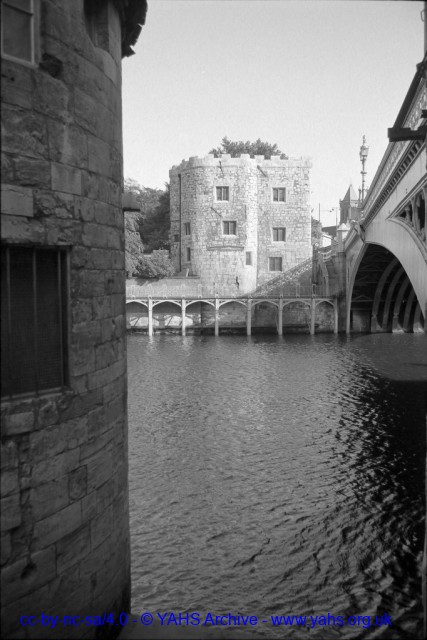
Medieval tower originally part of city's defences.
Information panel:
'Lendal Tower dates from the 13th century. Every night a great iron chain, stored in the tower, was stretched across the River Ouse to Barker Tower on the opposite bank. The chain prevented boatmen from entering the city without paying tolls and also protected the city in times of trouble or war.
'In the 17th century Lendal Tower's role changed from defender to provider. Fresh water was piped throughout York from the tower, which became known as 'the Waterhouse' in 1631. The mechanisms for pumping the water were improved over time until a steam engine was installed that was capable of producing 18 horsepower, raising 18 gallons of water at a stroke, or 10,500 gallons an hour. It toiled away in Lendal Tower from the 1780s until 1836, after which it was moved to a purpose-built engine house. York Waterworks, who leased the tower from the council for a peppercorn rent, then used it as a store and offices until 2000. It is now a private residence.'
In 1677 the tower was leased to Mr Henry Whistler in order to provide a 'Waterhouse or Waterworks for the service and accommodation of the inhabitants'.
It seems that Whistler subcontracted the actual work:
"Henry Whistler, Articles of Agreement with William Pawley and Edward Dallow, April 8,1682: recites the Grant from the Mayor and Authorities of York to the said Henry Whistler, April 1, 1677, of the "Ancient Building or Tower called the Water-house Tower, situate on the East side of the River Ouse, used as a Water-house, with Waterworks, for the supply of the Citizens of York with Water, &c. This agreement covenants that Pawley and Dallow shall build new works on the site of said Tower, fully efficient to supply the City with Water for private use: and large public Cocks for use in case of Fires, and enjoy the Profits for Forty-two years. Dated April 8, 1682." (Fairbank)
In 1682 a pump was installed supplying water through wooden pipes for two hours every other day (not Sundays). A steam engine and pump were first installed in 1769. Subsequently, further improvements were made including the provision of a more powerful steam pumping engine in 1836. This was housed in a separate building adjacent to the tower. Lendal Tower's role as the primary source of York's water ceased in 1846 with the establishment of the York New Waterworks Company at Acomb Landing (NYK00393) in 1846.
In 2015 was being used as self-catering accommodation.
Further Reading and References :-
YAHS - Hatcher Card Index. Research funded by the Yorkshire Arts Association 1972.
Hatcher, J. The industrial architecture of Yorkshire. Phillimore, 1985
http://borthcat.york.ac.uk/index.php/york-waterworks-company
Fairbank, F.R., "The Waterworks at York in 1682", YAJ, V15, p120,1900. https://archive.org/details/YAJ015/page/120
Help us improve this entry
Grid Ref :- SE 59996 51962
Co-ordinates :- Lat 53.960273 , Long -1.087097
Local Authority :- York City Council
Pre 1974 County :- Yorkshire - North Riding
Site Status :- Listed - Grade I
Historic England List No :- 1257086,
Site Condition :- Site refurbished to residential housing
Medieval tower originally part of city's defences.
Information panel:
'Lendal Tower dates from the 13th century. Every night a great iron chain, stored in the tower, was stretched across the River Ouse to Barker Tower on the opposite bank. The chain prevented boatmen from entering the city without paying tolls and also protected the city in times of trouble or war.
'In the 17th century Lendal Tower's role changed from defender to provider. Fresh water was piped throughout York from the tower, which became known as 'the Waterhouse' in 1631. The mechanisms for pumping the water were improved over time until a steam engine was installed that was capable of producing 18 horsepower, raising 18 gallons of water at a stroke, or 10,500 gallons an hour. It toiled away in Lendal Tower from the 1780s until 1836, after which it was moved to a purpose-built engine house. York Waterworks, who leased the tower from the council for a peppercorn rent, then used it as a store and offices until 2000. It is now a private residence.'
In 1677 the tower was leased to Mr Henry Whistler in order to provide a 'Waterhouse or Waterworks for the service and accommodation of the inhabitants'.
It seems that Whistler subcontracted the actual work:
"Henry Whistler, Articles of Agreement with William Pawley and Edward Dallow, April 8,1682: recites the Grant from the Mayor and Authorities of York to the said Henry Whistler, April 1, 1677, of the "Ancient Building or Tower called the Water-house Tower, situate on the East side of the River Ouse, used as a Water-house, with Waterworks, for the supply of the Citizens of York with Water, &c. This agreement covenants that Pawley and Dallow shall build new works on the site of said Tower, fully efficient to supply the City with Water for private use: and large public Cocks for use in case of Fires, and enjoy the Profits for Forty-two years. Dated April 8, 1682." (Fairbank)
In 1682 a pump was installed supplying water through wooden pipes for two hours every other day (not Sundays). A steam engine and pump were first installed in 1769. Subsequently, further improvements were made including the provision of a more powerful steam pumping engine in 1836. This was housed in a separate building adjacent to the tower. Lendal Tower's role as the primary source of York's water ceased in 1846 with the establishment of the York New Waterworks Company at Acomb Landing (NYK00393) in 1846.
In 2015 was being used as self-catering accommodation.
YAHS - Hatcher Card Index. Research funded by the Yorkshire Arts Association 1972.
Hatcher, J. The industrial architecture of Yorkshire. Phillimore, 1985
http://borthcat.york.ac.uk/index.php/york-waterworks-company
Fairbank, F.R., "The Waterworks at York in 1682", YAJ, V15, p120,1900. https://archive.org/details/YAJ015/page/120
The compilers welcome corrections or additional information on all sites.
Any information provided will be verified before appearing on the web site.
Email comments
Contributor :- Daniel Balmforth - 4 July 2015
Copyright :- cc-by-nc-sa 4.0 © Daniel Balmforth
Copyright :- cc-by-nc-sa 4.0 © Daniel Balmforth